Free printable AAC boards for the classroom
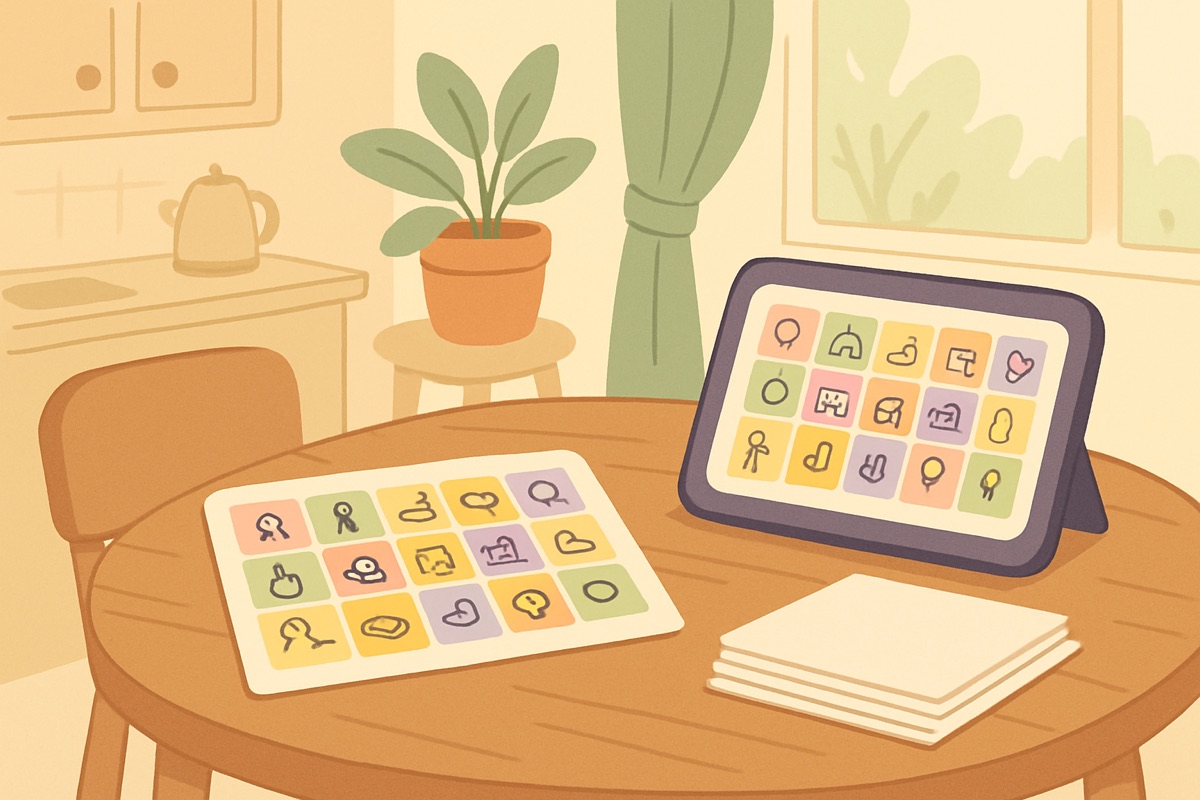
Paper communication boards are the duct tape of classroom AAC: free, fast, unbreakable, and useful in about forty situations. They don’t need charging, they survive juice, they photocopy for the sub folder, and no IT ticket is ever involved. If your classroom includes even one student who’s nonspeaking, minimally speaking, or just quiet under stress — and most classrooms do — printed boards earn their laminate immediately.
The boards worth printing first
A general core board — the flexible words that work all day: more, stop, help, want, go, look, all done, yes, no, like, don’t like, my turn. This is the workhorse. Tape it where you teach.
Center/activity boards — one per high-traffic zone, with the words that zone actually needs: art center (paint, cut, glue, more paper, help), blocks (build, crash, tall, my turn), snack (open, more, all done, water).
A feelings board — mad, sad, scared, tired, sick, happy, hurt — for the moment a dysregulated student can’t produce words but can land a finger. This board de-escalates more incidents than any chart.
A recess/hallway board on your lanyard — tiny, six cells, the words that leave the room with you: bathroom, water, help, hurt, wait, line up.
Where to get them: SpeakAnyWay’s free printable boards cover these classroom staples ready to print, and Project Core offers free universal core boards from UNC’s literacy-and-disability team. Between the two you can paper a classroom this week for the cost of laminating pouches.
Using them (the part that matters)
A board on the wall is decor until adults touch it. Two habits turn decor into communication:
- Point while you talk — a few times an hour, during real moments. “Time to stop — tap — line up.” You’re modeling how the board works for every student watching, not just the one with the IEP.
- Honor every use. Any student who taps help gets help, even the chatty ones doing it for novelty. A board that works for everyone stays cool to use; a board that’s only for one kid becomes a stigma object.
That second point is the classroom superpower: printed boards are universal supports. The nonspeaking student gets a voice, the anxious student gets a low-stakes channel, the pre-readers get picture-supported routines, and nobody is singled out — because the tool belongs to the room.
The fine print
Boards drift out of date — the class pet dies, the schedule changes, December happens. Re-print quarterly, and keep copies in the sub folder (sub-friendly visuals are their own post). And when one student uses the boards heavily, that’s information: bring it to your SLP and the family — it may be the start of a bigger AAC conversation that paper alone shouldn’t carry.
Total setup cost: a prep period and some laminate. Few classroom investments return more communication per dollar — especially at zero of them.
Frequently asked questions
Are paper boards enough for a student who needs AAC, or do they need a device?
Paper is a real AAC tool and an excellent classroom layer, but a student with significant communication needs deserves an SLP evaluation for a full system. Print boards support everyone today; they don't replace the assessment conversation.
How many boards should I laminate for one classroom?
Start with three placements: one general core board at the front, one at each high-traffic center, and one clipped to your lanyard or clipboard. Add topic boards as units rotate. When a board hasn't been touched in a month, retire or move it.