10 questions to ask before paying for any AAC tool
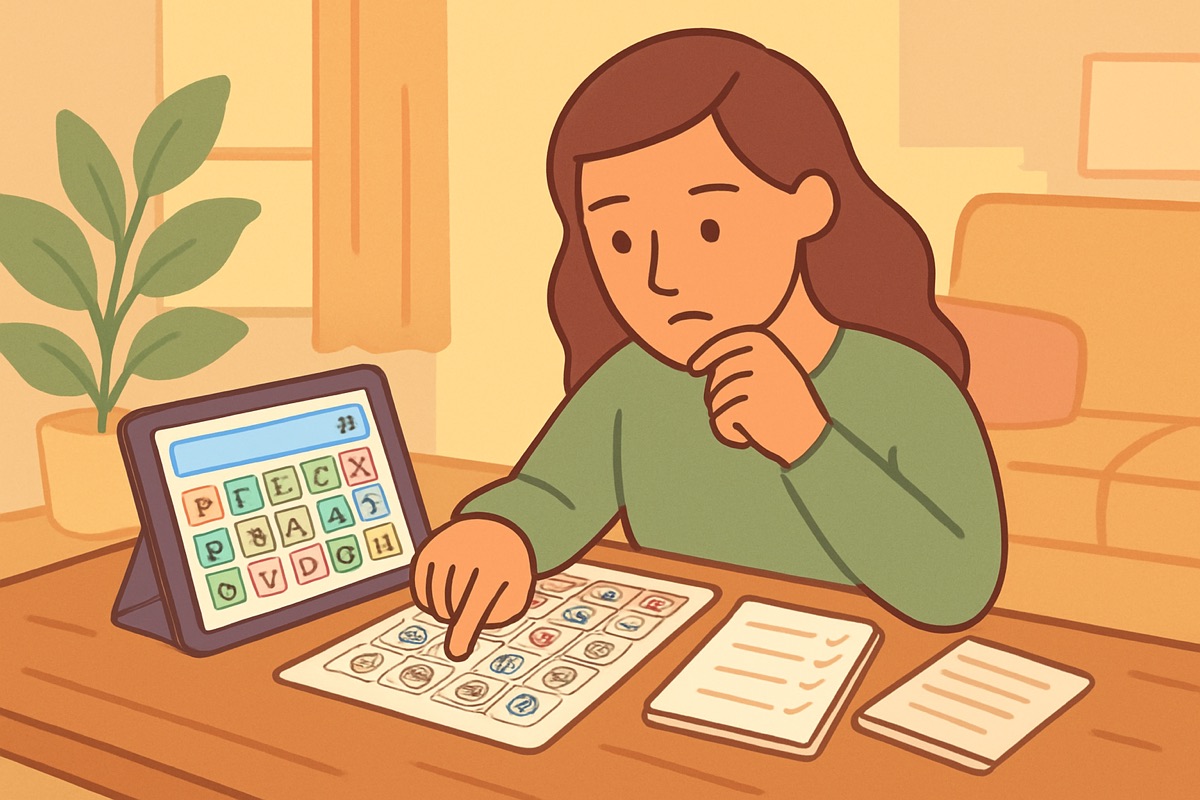
AAC purchases get made at vulnerable moments — a fresh diagnosis, a long-awaited evaluation, a child’s frustration boiling over — which is exactly when families are easiest to sell to. These ten questions are your armor. Ask them of any app, device, or program, ours included.
Ownership and exit
1. What happens to our boards if we stop paying? The vocabulary you build over years is your child’s voice. If the answer is “it’s locked to our subscription,” weigh that as the real cost it is — and screenshot everything regardless (switching apps is survivable, but only if you can see what you had).
2. Can we export or copy what we build? Paper printouts, images, files — any exit path counts. “No export, no printing” means the vendor is betting you’ll never leave, using your child’s words as the stake.
3. What does the free tier or trial actually do? A free level that builds and speaks a real board is a genuine test drive. A trial that watermarks, mutes, or caps everything until you pay tells you the company leads with pressure — useful data about the support you’ll get later.
The real price
4. What’s the total cost over three years? Subscriptions look small monthly; one-time purchases look big once. Multiply everything out — including the “premium voices” and “extra features” upsells — and compare honestly.
5. What hardware does it truly require? “Works best on” sometimes means “unusable without” a newer tablet, a specific stylus, a rugged case. Add that to the price.
6. What happens when the device breaks or the tablet dies? Warranty terms, loaner programs, or — for apps — whether your boards live in an account you can restore on any replacement hardware in ten minutes.
Fit for your actual child
7. Can it grow from 6 words to 600? Your child’s system next year should be an expansion, not a migration. Ask to see what a beginner board and an advanced layout look like in the same product.
8. Does it match how your child accesses things? Touch targets sized for their motor skills, symbol styles they respond to, voice options they tolerate — and if eye-gaze or switch access is on your horizon, ask now, because it changes the whole answer.
9. Who else can use and update it? Communication happens at school, at grandma’s, in the car with the babysitter. A system only one parent can edit, on one device, becomes a bottleneck with a subscription fee.
The one that reveals the vendor
10. What does the company promise? Read the marketing. Careful companies promise access to communication; careless ones promise outcomes — “first words in weeks!” No honest AAC product can promise outcomes, because children aren’t inputs. If the sales pitch overpromises, expect the same relationship with truth after they have your card number.
Take the checklist with you, take your time, and remember the ground rule from what AAC really costs: you can always start free while you decide. The vendors will keep.
Frequently asked questions
What's the single biggest red flag when evaluating an AAC product?
Any answer to 'what happens to our boards if we leave?' that amounts to 'they're gone.' A vendor confident in their product doesn't need your child's vocabulary as a hostage. Close behind: outcome promises with timelines.
Should we ask our SLP before buying an app, even a cheap one?
If you have an SLP, yes — a two-minute 'any reason this is wrong for her?' catches access and vocabulary-organization mismatches early. But don't let not-having-an-SLP-yet delay cheap starts like paper boards or free tiers; those are safe to try while you get one.
Sources
This is lived experience and research, not medical advice — your SLP knows your child.