A school-morning routine board that actually gets used
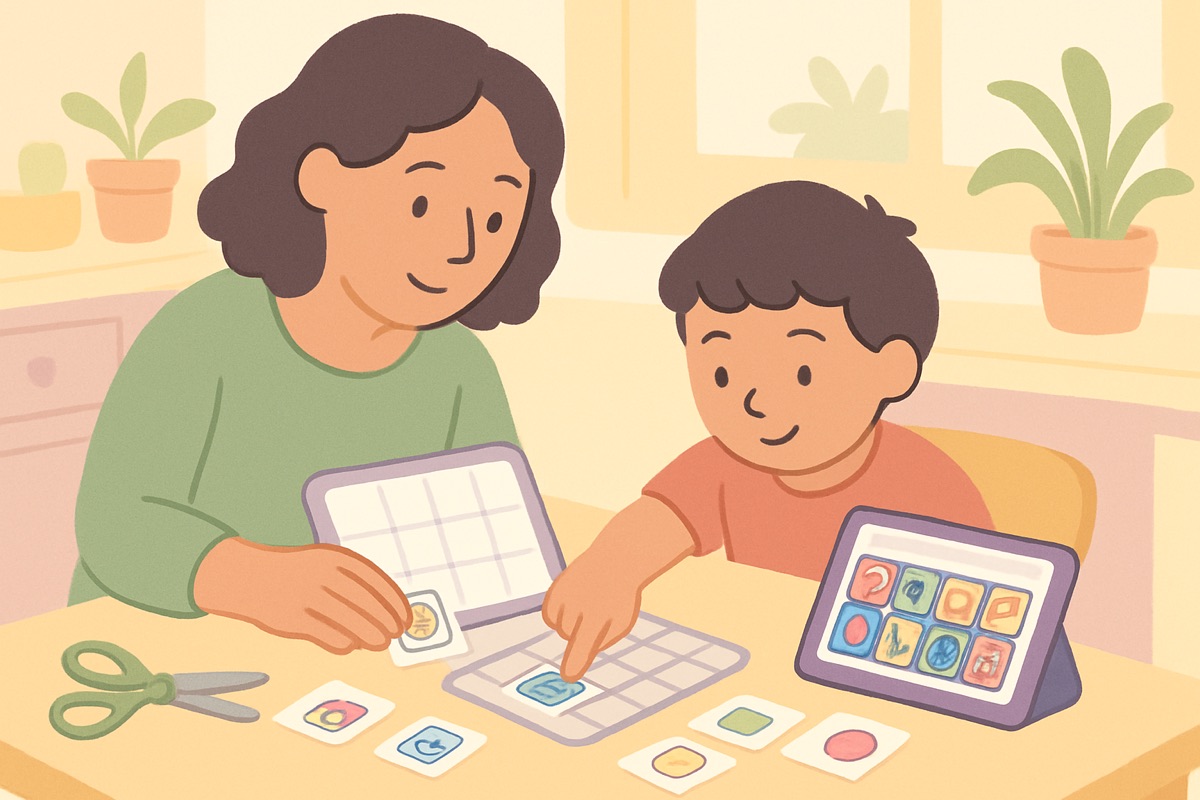
School mornings compress everything hard about communication into forty-five minutes: time pressure, transitions, big feelings, and a child who needs to cooperate with about nine instructions before they’re fully awake. A good routine board doesn’t make mornings magical. It makes them sayable — in both directions.
What goes on it
Keep it to one board, twelve to sixteen cells:
The sequence words: wake up, potty, get dressed, eat, brush teeth, shoes, backpack, bus/car. These do double duty — you’ll tap them to narrate what’s next, and your child can tap to ask or confirm.
The friction words: no, wait, help, not yet, five more minutes. Mornings fail at the friction points, not the steps. A child who can tap “wait” gets to push back like a person instead of going boneless on the floor. (You won’t always grant the wait — but being heard changes the temperature.)
The feelings row: tired, mad, sad, excited. Two taps of “tired” at 7:05am is your child telling you the actual problem. That’s gold — respond to it (“I know, buddy. Tired. Shoes anyway.”) and the board earns its wall space.
One lookahead: school plus whatever’s motivating there — the friend, the class pet, gym day. Mornings move better toward something.
Where it lives
Tape it at your child’s eye level in the path you already walk — the hallway, the back of the front door, next to the shoe basket. This is the whole trick. A morning board in a drawer is a morning board that retired. If mornings sprawl across rooms, print two copies; paper is cheap.
How to run it
- Narrate with your finger. “Shoes next” — tap shoes. “Then bus” — tap bus. You’re modeling the routine and the vocabulary in one motion, one second per tap.
- Give the pushback words away free. Model wait and not yet yourself (“One minute — WAIT — okay, coffee first”). A board that only contains compliance words is a to-do list, not a voice.
- Respond to feeling words before step words. “Mad” answered with “You’re mad. Mornings are hard.” takes five seconds and de-escalates better than any countdown.
- Let the board take the blame. “Board says teeth next” lands softer than one more parental command. Small trick, real mileage.
When it falls apart
It will, some days. The bus comes early, someone can’t find the left shoe, the board gets ignored entirely. That’s not failure — routines are learned across hundreds of mornings, not five. The board’s job is to make the average morning a little smoother and the hard mornings a little more understood. It compounds.
If you’d like the board to speak the words aloud — some kids attend better to the voice than the picture — SpeakAnyWay can generate a morning-routine board you customize to your exact sequence, then print for the hallway too.
Build it Sunday night. Tape it up. Tap “shoes” Monday and see what happens.
Frequently asked questions
Is this the same as a visual schedule?
They're cousins. A visual schedule shows what happens next (first shoes, then backpack); a communication board lets your child say things during it (no, help, wait, where's my...). Mornings go best with both — the schedule carries the sequence, the board carries the conversation.
We're too rushed at 7am to add one more thing. Honestly, is this realistic?
The board isn't an activity you add — it's taped to the wall in the path you already walk. Tapping 'shoes' as you say 'shoes' costs about one second. If a morning is on fire, skip it; the board will still be there tomorrow.