3 boards every new communicator needs first
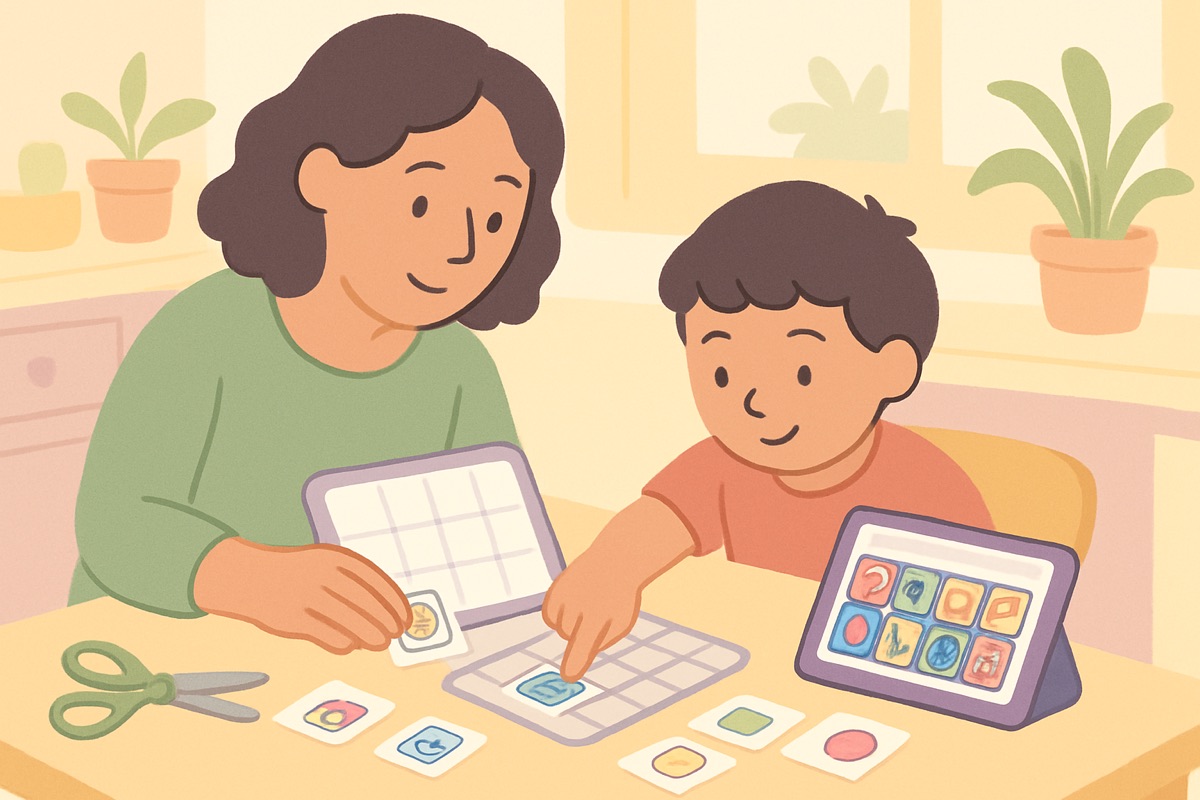
The hardest board to make is the first one — not because it’s technically hard, but because a blank grid asks you to summarize your whole child in twelve squares. So don’t start from blank. Start from these three, in this order.
Board 1: First words (the workhorse)
This is the board that lives on the kitchen table. Eight to twelve words that do the most work in a day:
- more — the single most useful early word; works on everything
- all done / stop — the power to end things is half of communication
- help — replaces a whole category of frustration
- want — pairs with pointing at almost anything
- drink, eat — daily and motivating
- yes, no — worth their weight in gold
- go — cars, swings, chase games, leaving
Notice what’s not here: nothing cute, nothing seasonal, no “please.” Early board real estate goes to words that change what happens next.
Board 2: Feelings (the pressure valve)
A child who can’t say “it hurts” or “I’m mad” still tells you — usually with behavior that gets labeled a problem. A feelings board gives those messages a better exit: hurt, mad, sad, scared, happy, tired, sick, hungry.
Two tips that matter here. First, model feelings when you feel them — tap “tired” when you’re tired, “happy” during a good moment — so the words arrive without pressure. Second, when your child uses one, believe it and respond to it, even mid-meltdown. “You’re MAD. Okay. I hear you.” That board earns trust or it earns dust.
Board 3: Favorites (the reason to talk)
Everything your child loves, on one board: the show, the characters, the snack, the park, the people, the weird beloved object nobody else understands. This is the board that answers the question every new communicator is silently asking: what’s in this for me?
Communication starts where motivation lives. A child who won’t glance at “help” will cross the room to tap “Bluey.” That’s not a failure of the system — that is the system. Requesting favorites is the on-ramp; everything else merges in later.
Making them
Keep the same few core words (more, stop, help) in the same positions on all three boards — communicators find words by location, and consistency is what makes tapping fast. Use clear symbols or real photos (real photos shine on the favorites board — the actual dog beats a clip-art dog).
You can draw these on paper this afternoon, and paper is a fine start. If you’d rather have them speak out loud, this is exactly what SpeakAnyWay was built for — describe the board you need and the AI drafts it, then you swap in your child’s real words and photos.
Three boards. Maybe an hour of making, total. That’s the whole starter kit — the rest grows from watching what your child reaches for.
Frequently asked questions
Should I make all three boards at once?
Make the first-words board today and start modeling with it. Add the feelings and favorites boards over the next week or two — three boards arriving gradually beats three boards arriving perfectly.
When do we add more boards beyond these three?
When real life asks for one. A doctor visit coming up, a new obsession, a holiday at grandma's — let your child's actual week tell you what board is next.