What is a communication board (and how do you actually use one)?
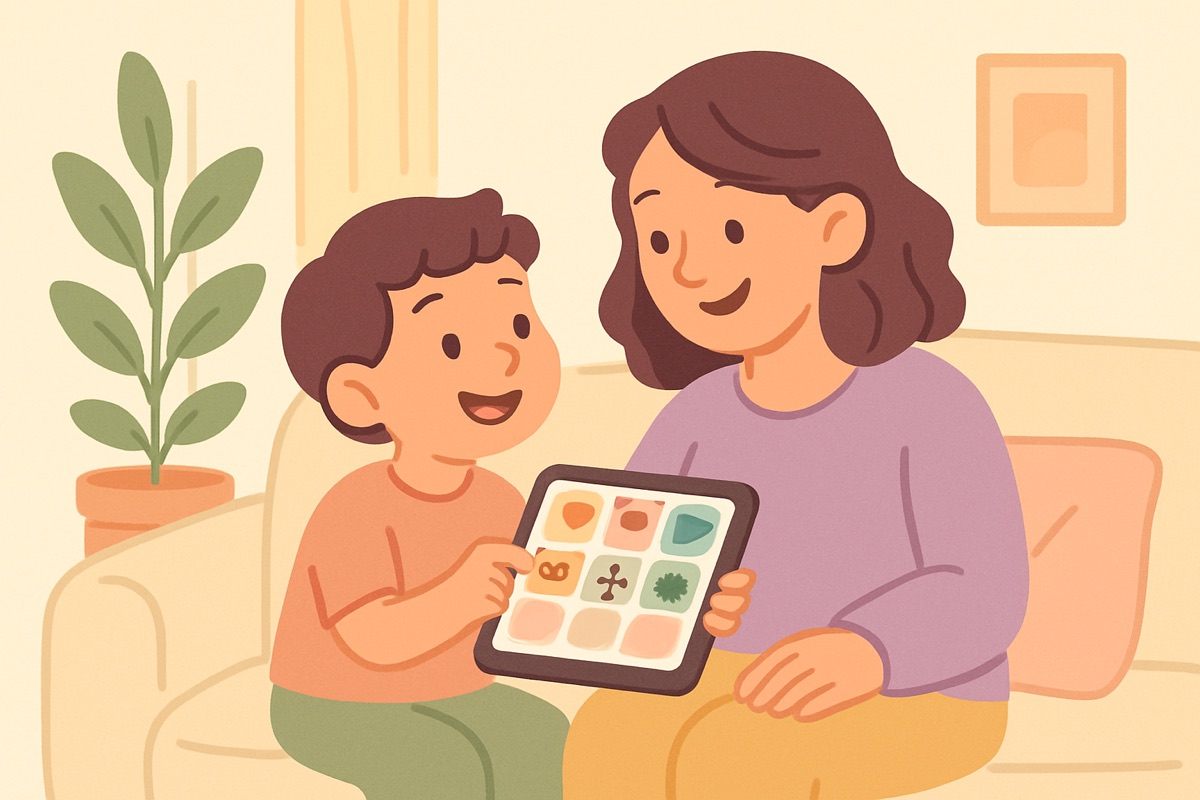
A communication board is exactly what it sounds like: a grid of pictures or symbols, each standing for a word, that a person can point to instead of — or along with — speaking. Tap the cup symbol: “drink.” Tap the raised hand: “help.” On paper, the listener reads the symbol; in an app, the board usually speaks the word out loud.
It’s one of the oldest, simplest tools in AAC (augmentative and alternative communication — the umbrella term for all the ways people communicate beyond speech), and it’s still one of the best first steps a family can take.
What goes on a board
A useful board is a mix of a few kinds of words:
- Requests — “more,” “drink,” “snack,” “play”: the words that get things. These usually get used first because the payoff is instant.
- Protests and exits — “no,” “stop,” “all done”: just as important. A child who can end things with a tap doesn’t have to end them with a meltdown.
- Comments and feelings — “yummy,” “wow,” “mad,” “hurt”: the words that make communication a conversation instead of a vending machine.
- Their favorites — the show, the toy, the person. Motivation is the engine; these words are the fuel.
Keep the layout consistent. If “more” lives in the top-left corner, let it live there on every board forever — communicators find words by location, the same way your thumbs find keys.
How you actually use it: model first
Here’s the part most people aren’t told: the board is for you first. Your child learned that words mean things by hearing you talk for months before they answered. Symbols work the same way. As you say “want more?”, tap more. When the bath ends, tap all done while you say it. This is called modeling (you’ll also see “aided language input” — same idea): using the board yourself, in real moments, with no test attached.
Then the not-so-secret second part: respond to everything. If your child taps “drink” — even accidentally — treat it as real. Get the drink, say the word, celebrate lightly. The lesson “my tap makes things happen” is the foundation the rest gets built on.
What to skip: hand-over-hand forcing, drilling (“where’s more? show me more!”), or hiding the board so it stays clean. A board only works when it’s always reachable — on the table at dinner, in the cart at the store, within arm’s reach at grandma’s.
Where boards fit in the bigger picture
A board isn’t the end of the road. Many communicators move on to fuller systems — apps with hundreds of words, sentence-building, voices they choose themselves. But nearly everyone starts here, and boards never really retire: the paper one stays taped up by the bath long after the tablet arrives, because real life includes water, dead batteries, and lost chargers.
Start with one board, one routine, and a lot of modeling. That’s genuinely the whole starting kit.
Frequently asked questions
Paper board or app — which should we start with?
Whichever you'll actually use today. Paper is cheap, sturdy, and screen-free; an app can speak aloud, hold more words, and go everywhere your phone goes. Many families use both — paper by the bathtub, app in the diaper bag.
How many words should a first board have?
Fewer than you think but more than one or two — six to twelve genuinely useful words is a comfortable start. Enough to say yes, no, more, and help; few enough that nobody gets lost hunting for a symbol.
Sources
This is lived experience and research, not medical advice — your SLP knows your child.