How to start AAC at home today — no evaluation required
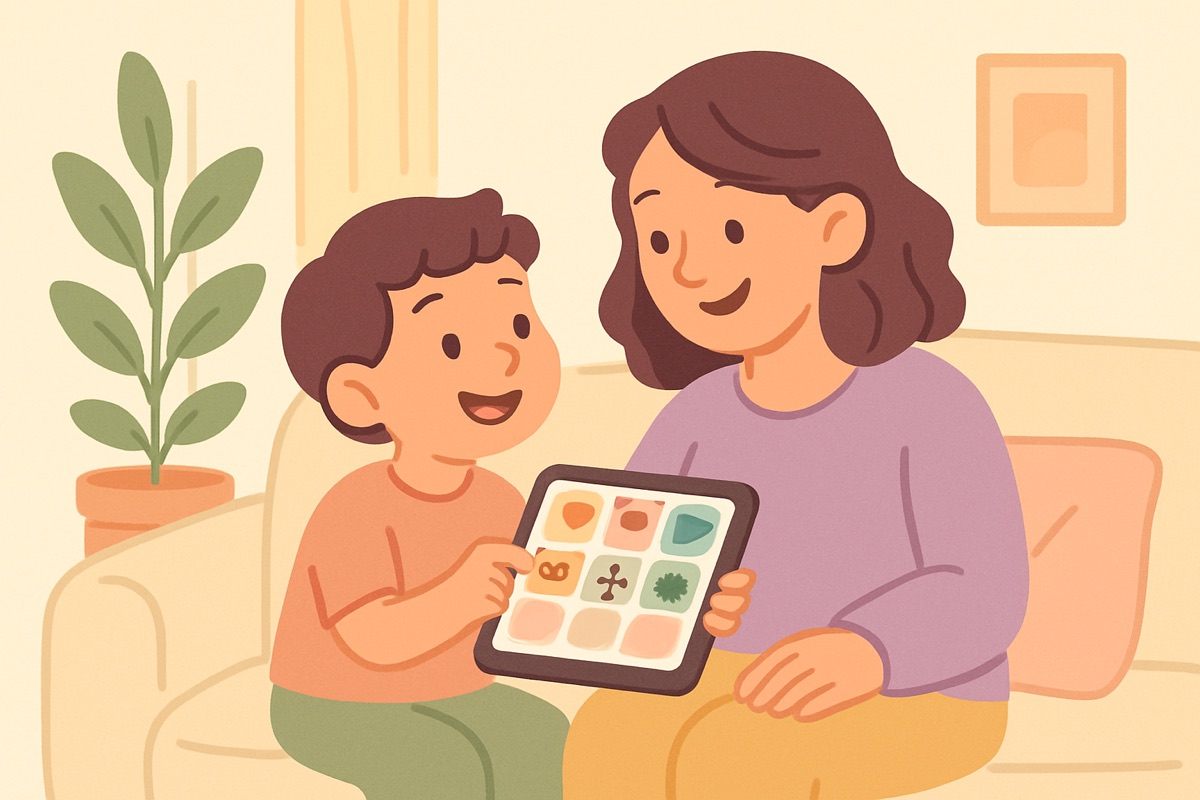
Maybe you’re on a waitlist for an evaluation. Maybe the evaluation happened and the follow-up hasn’t. Or maybe you just have a gut feeling your child needs more ways to communicate than they have right now. Good news: you can start today, from your kitchen table, and you don’t need anyone’s permission.
To be clear about what this is and isn’t: a speech-language pathologist (an SLP — a licensed communication specialist) brings expertise you’ll want on this journey, and a proper evaluation is worth having. But a simple communication board at home is a language support, like reading books aloud — any family can offer it, any time, and it won’t conflict with whatever comes later.
Here’s the starter version.
Step 1: Pick one routine
Don’t try to cover your child’s whole life. Pick a single, repeated, motivating moment — snack time, bath time, getting in the car. Routines are perfect because the same words come up every day, and repetition is how words stick.
Step 2: Make one small board
Make a board with six to twelve words that fit that routine. A good starter mix:
- A couple of requests: “more,” “drink,” “snack”
- A way to stop things: “all done,” “stop” — being able to say no matters just as much as yes
- A couple of feelings or comments: “yummy,” “help,” “uh oh”
Print it, or use an app on the tablet you already own. Keep it where the routine happens — taped to the fridge, next to the tub.
Step 3: Model, don’t quiz
This is the step that matters most. When you say “want more?”, point to more on the board as you say it. When snack ends, tap all done. You’re showing how the board works the same way you taught talking — by doing it, hundreds of times, with no test at the end.
What to avoid: grabbing your child’s hand and making them tap, or asking “show me ‘more’! Where’s ‘more’?” on repeat. Boards work when they’re a no-pressure offer, not a quiz. Model, wait, and let your child reach for it when they’re ready. The first time might be day one; it might be week four. Both are normal.
Step 4: Follow their lead
If your child taps something — even by accident, even the “wrong” thing — respond like it was on purpose. Tap “drink” → get the drink, say “drink! You asked for a drink!” That instant my tap made something happen is the engine of everything that follows.
Then watch what they care about and add those words. Trains, a favorite show, a beloved grandma — motivating words get used.
What this builds toward
A starter board isn’t the whole answer — over time you’ll likely want a fuller system, an SLP’s guidance, and words that go far beyond snack time. But every one of those next steps gets easier when your child already knows the big secret: pointing at symbols makes things happen. That lesson can start today.
Frequently asked questions
Am I allowed to start AAC without a professional evaluation?
Yes. A communication board at home is like reading to your child — a language support any family can offer. An SLP evaluation is still valuable for tailoring a full system, but nothing about starting at home requires permission or gets in its way.
What if I pick the wrong words or the wrong kind of board?
There's no wrong first board that a second board can't fix. Start with a handful of words tied to one routine, watch what your child reaches for, and adjust. AAC systems are meant to grow and change with the communicator.
Sources
This is lived experience and research, not medical advice — your SLP knows your child.