Handing off boards to families: a workflow that survives the school year
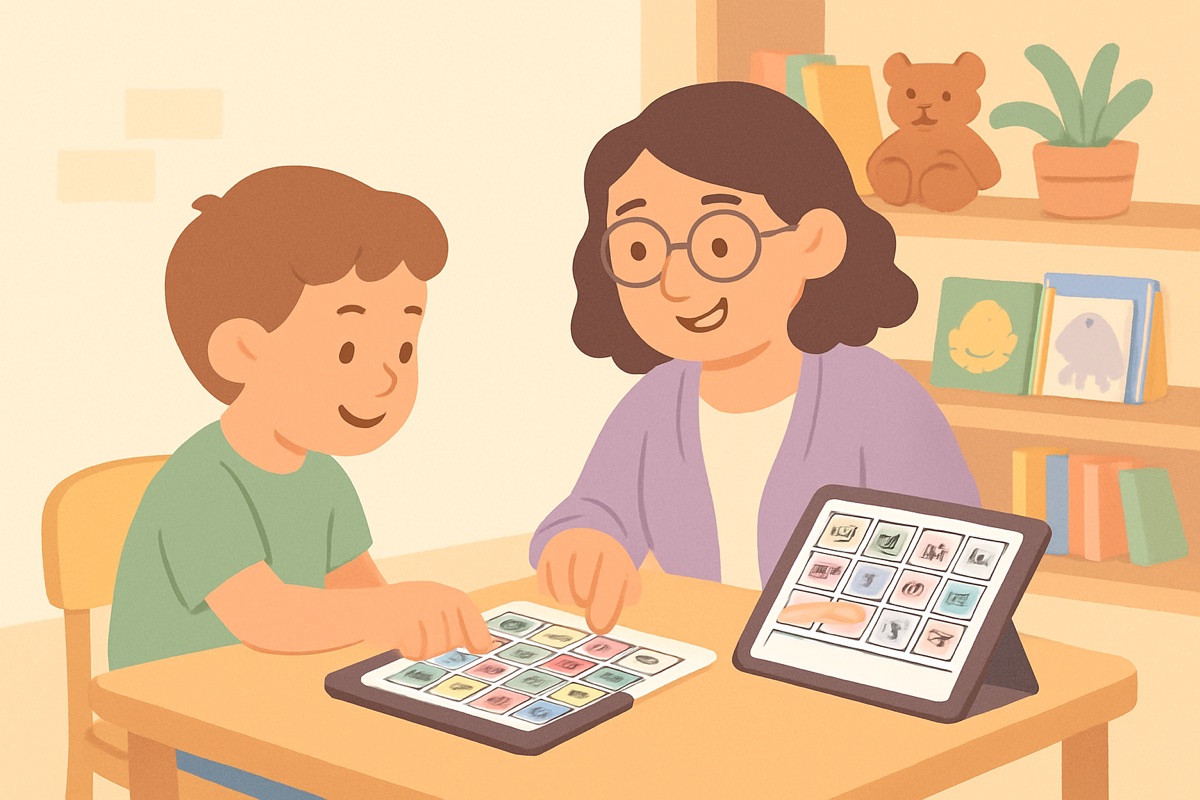
You know the arc. September: you build a beautiful board set, laminate the home copy, send it home with a note. October: you ask how it’s going and get a polite “we’ve been so busy.” November: the home copy surfaces in the backpack, pristine. The student’s AAC now works for six hours a day and goes silent at 3pm.
The problem isn’t the family. It’s that “here’s a board, good luck” isn’t a workflow. Here’s one that is.
Principle: hand off habits, not laminate
A family doesn’t need your materials; they need to know what to do at dinner. So the handoff artifact isn’t really the board — it’s three habits small enough to survive a chaotic household:
- Board lives where the kid is (counter, not backpack).
- Tap a word or two while you talk, during normal moments.
- Anything he taps, treat as said.
Put those on an index card. That card is the intervention.
The workflow
Week one: a live 10 minutes, not a sent packet. At pickup, on a video call, whatever you can get — model the three habits with the student in front of the parent, then have the parent do one round while you watch. One live rep converts more families than any handout, because it kills the “I’ll do it wrong” fear on the spot.
Give home a starting routine, singular. Not “use it at home” — “use it at dinner.” Families succeed at one routine and expand on their own; families handed the whole day succeed at none of it.
Make the same boards exist in both places. If your boards are digital, put them on the family’s own devices — SpeakAnyWay runs on whatever phone or tablet the family already has, and a board you update after Tuesday’s session is the board mom sees Tuesday night. No re-printing, no version drift, no “the home copy is three revisions old.” Send a paper copy too; paper is the backup that always boots.
Build a two-minute feedback loop. A weekly text beats a quarterly conference: “What did he tap at home this week? Anything he tried to say and couldn’t?” That second question is your vocabulary punch list — the words a family reports missing are the highest-value words you’ll add all month.
Close the loop visibly. When mom reports he kept tapping the dog’s name, add the dog’s photo to the board that week and tell her it came from her report. Families who see their input change the system stop being recipients and start being teammates. That’s the carryover engine, and it compounds through the whole year — the same loop that keeps the rest of the team on the same board.
October-proofing
The workflow decays at predictable points — new sibling, holiday chaos, device left at grandma’s. Expect it, name it at handoff (“some weeks it’ll fall apart; that’s normal, just restart at dinner”), and re-offer the 10-minute live rep once a semester. A family that knows lapses are expected re-engages; a family that thinks they’ve failed quietly disappears.
None of this is more total work than rebuilding disused boards in March. It’s the same hours, moved to where they compound.
Frequently asked questions
What if the family just doesn't engage, no matter what I send home?
Shrink the ask until it's unrefusable — one board, one routine, three habits on an index card. Non-engagement is usually overwhelm, not indifference. And check the practical blockers first: device access at home, language of materials, who actually does dinner.
Should home boards match school boards exactly?
The core layout should match — same key words in the same positions, so the student's muscle memory transfers. Fringe can and should differ; home life has different nouns. Same skeleton, local vocabulary.
Sources
This is lived experience and research, not medical advice — your SLP knows your child.